36+ free tools — no sign-up required

Launch Your Freelance Career

Professional invoices, financial calculators, time trackers, and 33+ more tools — all free, private, and running in your browser.

100% PrivateNo Sign-UpNo WatermarksAlways FreeWorks Offline

36 free tools in your browser

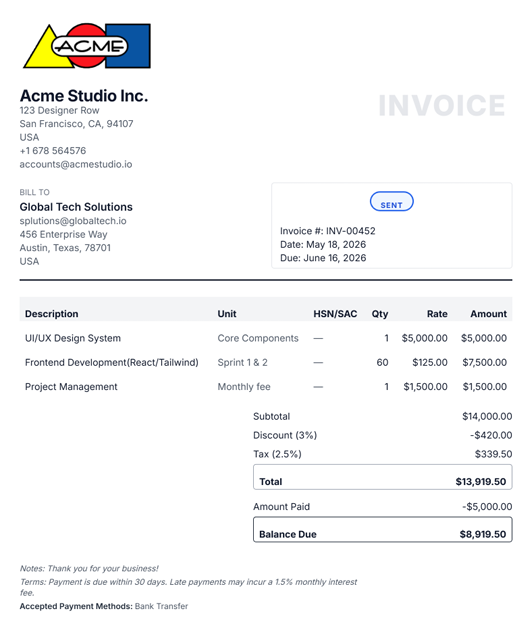
Professional invoice generated with MyFreelanceKit
PDF Ready

Tools available

36+

Simple & fast

How it works

01

Fill in your details

Open any tool and start typing — nothing is uploaded to a server. Your data stays in your browser.

02

See a live preview

Invoices, letters, and calculators update in real-time as you type. What you see is what you get.

03

Download or copy

Export to PDF, print directly, or copy text to your clipboard — completely free, no watermarks.

Everything you need

Your complete freelance toolkit

36+ free tools that run entirely in your browser. Pick a category or browse the full collection.

Pathways

Not sure where to start? Follow a path.

Just Starting Out

Beginner

From your first invoice to your first repeat client.

  1. 1Set your rate
  2. 2Create your first invoice
  3. 3Track your time
  4. 4Estimate your taxes
  5. 5Write a basic contract
Start the beginner pathJust Starting Out

Getting Serious

Building

Turn one-off gigs into a sustainable practice.

  1. 1Price retainers
  2. 2Build proposals
  3. 3Add NDA protection
  4. 4Track project profitability
  5. 5Plan savings goals
Start the growth pathGetting Serious

Scaling Up

Advanced

Manage multiple clients and protect your business at scale.

  1. 1Capacity plan your week
  2. 2Onboard clients professionally
  3. 3Build contract clause library
  4. 4Manage scope creep
  5. 5Automate payment follow-up
Start the scale-up pathScaling Up
100% Free · Always

MyFreelanceKit is free.Here's how to keep it that way.

No subscriptions. No paywalls. No data selling. Ever.
Just 36 free tools for every freelancer on the planet — from Kampala to Copenhagen to Karachi.
If MyFreelanceKit has saved you time or helped you get paid, a coffee keeps the lights on.

Buy us a coffee

From $1. Every contribution covers a bit of hosting, keeps the tools free for the next freelancer, and genuinely means a lot from a student-built project.

$1 ☕$3 ☕☕$5 ☕☕☕
Buy us a coffee ☕

Secure payment via Ko-fi · Takes 30 seconds

🔗

Share with one freelancer

The other way to support MyFreelanceKit is free. Share it with one freelancer who'd find it useful. That's how independent tools grow.

Built by one person. Hosted free. Used by freelancers in 50+ countries.

Trusted by freelancers

What people are saying

I used to put off invoicing because my old template was such a hassle to update. Now I just pop in here, type my hours, and download a perfect PDF. It genuinely takes two minutes.

Freelance Graphic Designer

The fact that I don't have to create yet another account to use this is amazing. It just works right in the browser, no watermarks, no limits. Easily the best free tool I've found for my freelance business.

Web Developer

As a consultant, client privacy is everything. When I realized the data stays entirely on my device and isn't uploaded to some server, I immediately switched all my invoicing over.

Business Consultant

Representative feedback from early users.

100% Private

Your data never leaves your browser

No Sign-Up

Start using tools instantly

Works Offline

No internet connection required

Always Free

No trials, no paywalls, no watermarks

Support

Frequently asked questions

Everything you need to know about MyFreelanceKit. Can't find what you're looking for? Reach out to us directly.

Yes — every tool is free with no trial period, no sign-up, and no credit card. We plan to offer optional premium features in the future, but the core toolkit will always be free.

All data stays in your browser using localStorage. Nothing is uploaded to our servers. When you close the tab, the only data that persists is what your browser saved locally on your device.

Yes. Once the page has loaded, most tools work without an internet connection. Calculations, form editing, and PDF generation all happen in your browser.

Absolutely. Our PDFs are rendered at high resolution using industry-standard libraries. They include proper typography, layout, and formatting suitable for sending to clients.

No. Every document you generate is watermark-free. The PDF you download is exactly what your client will see — clean and professional.

We currently offer 34+ tools spanning invoice generation, receipt making, estimate creation, time tracking, financial calculators, contract clauses, and more. We add new tools regularly.

The Ultimate Freelance Toolkit: Elevating Your Independent Business to New Heights

Welcome to the definitive destination for freelance professionals who are ready to transition from scraping by to thriving. The modern freelance landscape is evolving at a breakneck pace, and staying ahead requires more than just raw talent—it demands an arsenal of specialized tools, optimized workflows, and a strategic mindset. Whether you are a graphic designer, a full-stack developer, a specialized copywriter, or a strategic business consultant, the infrastructure you build around your core skills will ultimately determine your success, longevity, and profitability in the independent economy.

For decades, the narrative surrounding freelancing has been one of feast or famine. Independent workers would experience periods of intense, overwhelming workloads followed by terrifying droughts. But today, the most successful freelancers have rewritten this narrative. They operate not as solitary workers, but as single-person agencies. They leverage automation, refined processes, and high-leverage tools to manage the mundane, allowing them to focus entirely on deep, revenue-generating work. This is the ethos behind our platform: equipping you with the specialized toolkit necessary to build a resilient, scalable, and highly lucrative freelance enterprise.

Why Freelancers Need Specialized Tools

When you first start out as a freelancer, it is incredibly tempting to run your entire operation from a collection of disorganized spreadsheets, sticky notes, and a crowded email inbox. After all, your primary goal is to secure clients and deliver work. However, as your client base grows, the administrative burden grows exponentially. Every hour spent tracking down an unpaid invoice, drafting a contract from scratch, or manually organizing project files is a billable hour lost. The opportunity cost of disorganization is massive.

Specialized tools are not just about convenience; they are about capacity. By offloading administrative, financial, and operational tasks to purpose-built software, you artificially expand your capacity to take on more clients without burning out. Consider the typical freelance workflow without specialized tools:

  • Client Onboarding: Sending a generic email, waiting for a reply, sending a raw PDF contract, hoping the client knows how to digitally sign it, manually creating a Google Drive folder.
  • Project Management: Relying on email threads to track feedback, losing crucial assets in the shuffle, missing deadlines because there was no centralized timeline.
  • Invoicing and Payments: Creating a manual invoice in Word, saving it as a PDF, emailing it, and then anxiously checking your bank account every day for two weeks to see if a wire transfer cleared.

Now, contrast this with a streamlined, tool-optimized workflow:

  • Client Onboarding: An automated CRM pipeline sends a personalized intake form. Upon completion, a legally binding, templated contract is generated and sent via an e-signature platform. Once signed, an automated Zapier integration sets up the client's project board and Slack channel.
  • Project Management: Every task, asset, and piece of feedback is centralized in a project management tool like Asana or Notion, providing complete transparency for both you and the client.
  • Invoicing and Payments: Integrated financial software automatically generates invoices based on tracked time or project milestones, sends automated follow-ups for unpaid bills, and allows the client to pay instantly via credit card or ACH transfer.

The difference is not just in efficiency; it is in the client experience. When a client interacts with a freelancer who utilizes a professional toolkit, they immediately perceive a higher level of competence and reliability. This perceived value directly translates into your ability to command premium rates. A client is far more likely to agree to a $10,000 proposal if the entire engagement—from the initial proposal document to the final handover—feels polished, secure, and enterprise-grade.

The Hidden Costs of Generalist Software

Many freelancers attempt to save money by retrofitting generalist software for their specific needs. They might use a simple to-do list app meant for grocery shopping to manage complex web development sprints, or they might try to manage their complex freelance taxes using a basic personal finance tracker. The hidden cost here is friction.

Generalist software is designed for the lowest common denominator. It lacks the nuanced features that independent professionals require. For example, a specialized freelance invoicing tool will have features specifically designed for retainer billing, milestone-based payments, and expense markups—features that a generic invoice template fundamentally lacks. Furthermore, specialized tools often integrate seamlessly with one another, creating an ecosystem. Your time tracker talks to your invoicing software, which talks to your accounting software, which talks to your tax estimation tool. This interconnectedness is the holy grail of freelance operations, drastically reducing the cognitive load required to run your business.

Ultimately, investing in specialized freelance tools is an investment in your own sanity and scalability. It is the crucial step required to stop working IN your business and start working ON your business. By standardizing your operations through technology, you lay the foundation for sustainable growth, paving the way for the strategies and pillars we will explore in the subsequent sections of this comprehensive guide.

The Core Pillars of Freelance Success

To build a freelance business that is not only profitable but also resilient against market fluctuations and personal burnout, you must establish a strong foundation across four core pillars: Invoicing and Financial Management, Operational Efficiency, Legal Protection, and Strategic Pricing. Neglecting any one of these pillars can lead to structural weaknesses that threaten the entirety of your independent enterprise. Let us examine each of these crucial areas in exhaustive detail.

1. Invoicing and Financial Mastery

Cash flow is the lifeblood of any business, and for a freelancer, the invoice is the critical conduit for that flow. Financial mastery extends far beyond simply asking for money; it encompasses the entire lifecycle of revenue generation, from accurate time tracking to strategic tax planning.

Professional Invoicing: Your invoice is a reflection of your brand. It must be clear, concise, and legally compliant. Specialized invoicing tools allow you to brand your documents, itemize your services transparently, and, most importantly, offer frictionless payment options. Clients are more likely to pay quickly when they can do so with a single click via Apple Pay or a credit card, rather than navigating complex bank transfers.

Automated Follow-ups: Chasing late payments is the bane of the freelance existence. It creates awkward client dynamics and consumes valuable time. By automating your payment reminders, you remove the emotion from the equation. The software becomes the "bad cop," politely but firmly reminding the client of their obligations at 3, 7, and 14 days past due.

2. Operational Efficiency & Workflows

Operations refers to the internal machinery of your business—how you actually get the work done. A highly skilled freelancer with poor operations will always be out-earned by an averagely skilled freelancer with exceptional operations.

Standard Operating Procedures (SOPs): Every repetitive task in your business should be documented as an SOP. Whether it's setting up a new local development environment, conducting a client kickoff call, or formatting a blog post, having a checklist ensures zero mistakes and minimal cognitive load. As you scale, these SOPs become the training manual for your first subcontractors.

Asynchronous Communication: The most efficient freelancers fiercely protect their deep work time. Moving away from constant Slack pings and synchronous meetings to asynchronous updates (via tools like Loom or structured Notion boards) allows you to maintain momentum on complex projects while still keeping clients fully informed.

3. Ironclad Legal Protection

Hope is not a legal strategy. Operating without robust contracts is the fastest route to scope creep, unpaid labor, and catastrophic liability. Your legal pillar is your shield against the inevitable friction of doing business.

Comprehensive Contracts: A handshake agreement is worthless when a project goes south. Your Master Services Agreement (MSA) and Statement of Work (SOW) must clearly delineate deliverables, timelines, payment schedules, intellectual property rights, and kill fees. A strong contract doesn't just protect you; it sets clear boundaries that actually improve the client relationship by removing ambiguity.

Scope Creep Mitigation: Scope creep—the slow, insidious expansion of a project's requirements without corresponding budget increases—kills profitability. Your legal documents and operational workflows must include formal change request protocols. When a client asks for "just one more quick feature," your system must automatically trigger a conversation about budget and timeline adjustments.

4. Strategic, Value-Based Pricing

How you price your services determines the caliber of clients you attract and the ceiling of your income. The most critical transition a freelancer can make is moving away from selling time and toward selling value and outcomes.

The Hourly Trap: Hourly pricing inherently misaligns your incentives with the client's. If you become faster and more efficient at your job, you get paid less. Value-based pricing, on the other hand, ties your compensation to the financial impact you generate for the client. If your new landing page design increases their monthly recurring revenue by $50,000, charging a flat $10,000 fee is a massive bargain for them, regardless of how many hours it took you to build.

Tiered Proposals: Never present a client with a single price. Always offer three tiers (e.g., Bronze, Silver, Gold). This shifts the psychological question in the client's mind from "Should I hire this freelancer?" to "Which package from this freelancer should I choose?" The highest tier also serves as an anchor, making the middle tier—your target engagement—appear incredibly reasonable by comparison.

Scaling Your Freelance Business from Zero to Six Figures

Crossing the six-figure threshold as a solo freelancer is a monumental milestone. It signifies the transition from a precarious gig worker to a stable, highly compensated professional. However, scaling to $100,000 and beyond requires a fundamental shift in strategy. You cannot simply work twice as many hours to double your income; you will hit a physical ceiling. Scaling is about leverage, positioning, and systematic growth. Let us break down the exact blueprint for scaling a freelance business to six figures and beyond.

Phase 1: Niche Selection and Extreme Positioning (The $0 to $30k Stage)

In the beginning, the natural instinct is to be everything to everyone. You take any job that pays, regardless of the industry or the specific skill required. While this is necessary for initial survival and portfolio building, it is fatal to long-term scaling. Generalists are a commodity, and commodities compete on price. Specialists are a scarce resource, and scarce resources command premium rates.

  • Identify the Intersection: Your ideal niche lies at the intersection of your strongest skills, an industry you understand deeply, and a market with high purchasing power. Instead of being a "freelance writer," become a "B2B SaaS technical whitepaper specialist." The latter can charge ten times more than the former.
  • Craft a Magnetic Value Proposition: Your website and LinkedIn profile must communicate exactly who you help and the specific outcome you deliver. "I design websites" is weak. "I build high-converting Shopify storefronts that increase average order value for DTC wellness brands" is a value proposition that clients will happily pay top dollar for.

Phase 2: Productized Services and Retainers (The $30k to $70k Stage)

Once you have established your niche and have a steady stream of clients, the next bottleneck is the custom proposal process. Writing bespoke proposals for every single lead is incredibly time-consuming. To break through the mid-five-figure plateau, you must standardize your offerings.

  • Productize Your Offerings: Turn your most common services into fixed-price, fixed-scope "products." For example, a "Website Audit and Strategy Roadmap" for $1,500, delivered in precisely 5 days. Productization removes friction from the buying process, eliminates scope creep, and allows you to optimize your delivery process to maximize hourly yield.
  • Establish Recurring Revenue: The anxiety of the freelance feast-or-famine cycle is cured by Monthly Recurring Revenue (MRR). Transition your best clients into retainer agreements. Offer ongoing maintenance, monthly content quotas, or continuous advisory services. A baseline of $4,000 in monthly retainers completely changes your psychological approach to business, allowing you to be highly selective with the new projects you take on.

Phase 3: Subcontracting, Automation, and Inbound Lead Generation (The $70k to $100k+ Stage)

To cross the six-figure mark without working 80-hour weeks, you must decouple your time from your income. You need systems that generate leads while you sleep, and a delivery mechanism that doesn't rely solely on your own two hands.

  • Inbound Marketing Ecosystem: Stop relying entirely on cold outreach or unpredictable job boards. Invest in SEO, create high-value content (like case studies detailing how you solved specific problems for niche clients), and build an email list. Position yourself as a thought leader so that pre-qualified, high-budget leads come directly to your inbox.
  • Strategic Subcontracting: You do not need to build an agency, but you should build a trusted roster of complementary freelancers. If you are a developer, partner with a designer. If you are a strategist, hire junior implementers. By white-labeling or delegating the lower-value aspects of your projects, you act as the project director. You maintain the premium client relationship and capture the margin, effectively scaling your output exponentially.
  • Relentless Automation: Every manual task must be audited. Use Zapier or Make to connect your CRM, email, invoicing, and project management tools. If a task requires no creative input, it should be automated. This radical efficiency protects your most valuable asset: your deep, focused, creative energy.

Scaling to six figures is a deliberate act of engineering your business model. It requires saying "no" to bad clients, fiercely protecting your margins, and constantly upgrading both your skills and your operational toolkit.

A Deep Dive into Managing Client Relationships

In the freelance economy, your technical skills—whether coding, writing, or design—are merely the table stakes. The true differentiator between a freelancer who struggles and one who commands premium rates and enjoys endless referrals is client relationship management. Masterful client management transforms one-off transactional gigs into lucrative, multi-year partnerships. It turns skeptical buyers into enthusiastic brand advocates. Let's explore the advanced psychology and tactical frameworks for managing clients at the highest level.

The Psychology of the Freelance Client

To manage a client effectively, you must understand their underlying fears and motivations. When a client hires you, they are essentially buying trust. They are taking a risk—often involving their personal reputation within their company or a significant portion of their small business budget—on your ability to deliver. Their primary anxiety is losing control and losing money.

Your entire communication strategy should be designed to mitigate this anxiety. You do this through hyper-transparency, proactive communication, and extreme reliability. If a client ever has to email you to ask, "What's the status of this project?", you have failed at proactive communication. You must answer their questions before they even realize they have them.

The Framework for Flawless Onboarding

The tone of the entire engagement is set during the first 72 hours of onboarding. A sloppy onboarding process breeds skepticism; a highly structured, professional onboarding process establishes overwhelming authority.

  • The Kickoff Package: The moment the contract is signed and the deposit is paid, the client should automatically receive a comprehensive welcome package. This should include a welcome video, a detailed project timeline, a breakdown of exactly what is needed from them (and when), and a clear outline of your communication boundaries (e.g., "I respond to emails between 10 AM and 4 PM on weekdays. For emergencies, use this specific channel.").
  • The Discovery Workshop: Never start executing work immediately. Begin with a paid discovery phase or a deep-dive workshop. This aligns expectations perfectly, extracts all necessary contextual information from the client's brain, and positions you as a strategic consultant rather than a mere order-taker.

Navigating Conflict and Scope Creep

Friction is inevitable in any complex project. How you handle that friction dictates your reputation. The most common source of conflict is scope creep.

When a client makes an out-of-scope request, inexperienced freelancers often say "yes" out of a desire to please, silently resenting the client as their profit margin evaporates. The professional freelancer responds differently. They use the "Yes, and..." technique.

"Yes, we can absolutely add that dynamic animation to the homepage header. Because that falls outside our original Statement of Work, it will require an additional $850 and will push our launch date back by two days. Shall I send over a change order for your approval so we can get started on it?"

This response is polite, accommodating, but utterly unyielding on boundaries. It forces the client to evaluate the true value of their request. Nine times out of ten, they will either gladly pay the extra fee (increasing your revenue) or decide the feature isn't necessary (protecting your time).

The Art of the Offboarding and the "Ask"

The project does not end when you deliver the final files. The offboarding process is your prime opportunity to generate future business. A proper offboarding includes a handover call where you walk them through the deliverables, ensuring complete satisfaction.

This is the moment of peak client happiness. It is exactly the moment you must ask for three things:
1. A detailed testimonial or LinkedIn recommendation.
2. A referral to one specific person in their network who could use your services.
3. A conversation about a monthly retainer to maintain or iterate upon the work you just completed.
Mastering this lifecycle—from hyper-professional onboarding to strategic offboarding—is the ultimate secret to a sustainable, high-income freelance career.

Frequently Asked Questions About the Freelance Journey

Navigating the complex waters of independent business ownership inevitably raises questions. Below, we provide comprehensive, experience-backed answers to the eight most critical questions asked by freelancers aiming to scale their operations and maximize their revenue potential.

1. How do I effectively transition from an hourly rate to value-based pricing without losing clients?

The transition to value-based pricing requires a shift in your sales conversations. Instead of discussing your technical process or the time it takes, you must focus entirely on the client's business metrics. Ask questions like, "What is the financial impact of this problem remaining unsolved?" or "If this project is wildly successful, how much extra revenue will it generate for you over the next 12 months?" Once you quantify the value, you price your services as a fraction of that value (typically 10% to 20%). When pitching this to existing clients, phrase it as an upgrade: "To provide more predictable budgeting and focus on your core results rather than tracking hours, I am moving to flat-fee, outcome-based engagements."

2. What is the absolute minimum toolkit I need to start a professional freelance business?

While the ultimate goal is a fully integrated software stack, the minimum viable toolkit consists of four critical components: 1) A robust invoicing and payment processor (like Stripe, Bonsai, or Wave) to ensure you get paid professionally and quickly. 2) A legally vetted contract template (never operate without a Master Services Agreement). 3) A centralized project management tool (like Notion, Trello, or Asana) to organize tasks and client communications. 4) A professional custom email address (yourname@yourdomain.com via Google Workspace)—using a generic Gmail address instantly degrades your perceived professionalism and bargaining power.

3. How should I handle a client who refuses to pay an invoice or ghosts me after delivery?

Prevention is the best cure. Always require a significant upfront deposit (typically 50%) before commencing any work, and tie final delivery of assets (source files, website launch, etc.) to the final payment. If a client still ghosts, follow a strict escalation protocol: Send automated reminders at 3, 7, and 14 days late. At 30 days, send a formal "Demand for Payment" letter citing the late fee clauses in your contract. If the amount is substantial, you may need to escalate to a collections agency or small claims court. Often, a letter drafted on the letterhead of a legal service will prompt immediate payment.

4. At what point should I consider incorporating as an LLC or S-Corp instead of operating as a Sole Proprietor?

You should generally form a Single-Member LLC as soon as you have paying clients, as it provides a crucial liability shield, protecting your personal assets (house, savings) from business-related lawsuits. The transition to an S-Corp election is primarily a tax strategy. In the United States, a common rule of thumb is to consider S-Corp status when your net freelance profit consistently exceeds $60,000 to $80,000 per year. At this threshold, the savings on self-employment taxes usually outweigh the added payroll and accounting complexities associated with running an S-Corp. Always consult a CPA to analyze your specific financial situation.

5. How can I balance doing the actual client work with the necessity of marketing and finding new clients?

This is the classic "feast or famine" trap. The solution is time-blocking and consistency. You must treat "Business Development" as your most important, non-negotiable client. Dedicate a specific block of time—for example, every Tuesday and Thursday morning from 8:00 AM to 10:00 AM—strictly to marketing activities. This could be writing a newsletter, publishing a case study, updating your portfolio, or engaging in targeted cold outreach. You must execute this marketing block even when you are overwhelmed with client work, as the marketing you do today generates the leads you will need 60 days from now.

6. What is the most effective way to build a portfolio if I am just starting out and have no professional clients?

Do not wait for permission to do great work. The concept of "Permissionless Proof of Work" is highly effective. Identify a successful company or brand in your target niche. Audit their current website, copy, or app, and redesign or rewrite a portion of it to a vastly superior standard. Publish this as a detailed, unsolicited case study, explaining the strategic thinking behind your improvements. Send this directly to the decision-makers at that company, or share it publicly on LinkedIn or Twitter. High-quality speculative work demonstrates extreme competence and initiative, often leading directly to hired engagements.

7. How should I manage boundaries with clients who expect immediate responses at all hours of the day and night?

Boundaries are established during onboarding and reinforced through behavior. Clearly state your communication hours in your welcome packet (e.g., "M-F, 9 AM to 5 PM EST") and specify expected response times (e.g., "within 24 business hours"). Crucially, you must adhere to your own rules. If a client emails you at 11:00 PM on a Saturday and you reply, you have just trained them that you are available 24/7. Draft your replies if you are working off-hours, but schedule them to send at 9:00 AM on Monday morning. Consistent enforcement of boundaries commands respect and prevents burnout.

8. Should I publish my pricing on my website or keep it hidden and require clients to request a quote?

This is a heavily debated topic, but the most sophisticated approach for high-ticket freelancers is to provide "Starting At" or "Investment Tier" pricing rather than a rigid price list. Publishing a minimum threshold (e.g., "Custom Web Applications starting at $15,000") acts as an incredibly effective filter. It automatically disqualifies tire-kickers and low-budget leads, protecting your valuable time, while ensuring that the prospects who do reach out are pre-qualified and possess the necessary budget. It sets a premium anchor before the sales conversation even begins.