
Free guides for freelancers

The MyFreelanceKit Blog

Practical guides on invoicing, pricing, contracts, getting paid, and building a sustainable freelance business.

60 articles 8 categories No fluff, ever
Invoicing

How to Write a Professional Invoice in 2026

A complete invoicing guide covering every required field, formatting best practices, partial payments, international clients, and how to follow up when payment is late.
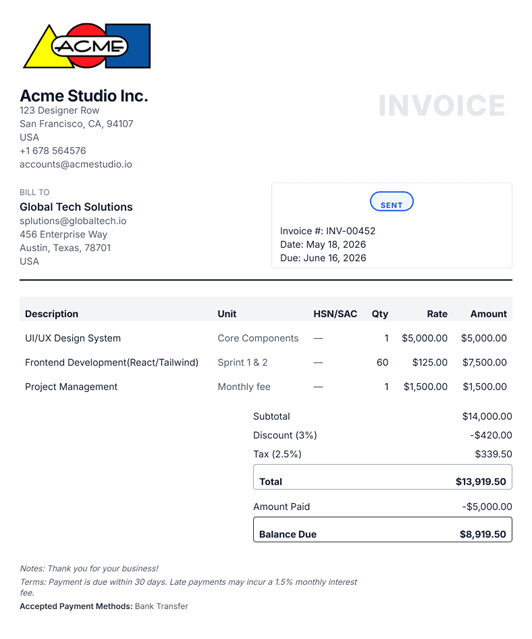
April 30, 20268 min read
Read article
Pricing

How to Set Your Freelance Rates in 2026: The Complete Pricing Guide

Cost-plus, market-rate, and value-based pricing with real calculation examples for web developers, designers, and virtual assistants.

April 30, 202610 min read
Read →
Invoicing

Invoice vs Receipt vs Estimate — What Is the Difference?

When to send each document, what fields each requires, and how they work together in a professional freelance workflow.

April 30, 20266 min read
Read →
Pricing

How to Raise Your Freelance Rates (Without Losing Clients)

Psychology, timing, math, email templates, and objection handling for professional rate increases.

April 30, 20266 min read
Read →
Contracts

Freelance Contract Essentials: 7 Clauses Every Project Needs

Scope, payment, IP, revisions, termination, liability, and dispute resolution in plain English — with red flags and signing tips.

April 30, 20266 min read
Read →
Payments

Invoice Payment Terms Explained: Net 30, Net 60, and Everything In Between

Cash flow impact, which terms for which clients, negotiation tactics, late fees, and mobile money context for Uganda and Africa.

April 30, 20266 min read
Read →
Getting Started

How to Get Your First Freelance Client (Step-by-Step Guide)

Practical steps to land your first paid client without a portfolio, without connections, and without cold calling — from positioning to first invoice.

April 30, 20269 min read
Read →
Invoicing

What Is a Purchase Order? A Plain-English Guide for Freelancers

What a PO is, when clients send them, what to do with one, and how to create your own. Everything freelancers need to know about purchase orders.

April 30, 20265 min read
Read →
Clients

How to Write a Freelance Proposal That Wins Projects

The exact structure, language, and psychology of proposals that convert — from the opening hook to the pricing section and acceptance close.

April 30, 20268 min read
Read →
Payments

How to Deal With a Client Who Won't Pay (Step-by-Step)

Escalation timeline from friendly reminder to formal demand letter — with email templates, late fee calculations, and when to involve a lawyer.

April 30, 20267 min read
Read →
Tax

Freelance Tax Guide for Uganda, Kenya & Nigeria (2026)

How self-employment tax works in Uganda, Kenya, and Nigeria — registration, rates, filing, and what freelancers actually owe. With free tax estimator.

April 30, 20269 min read
Read →
Invoicing

What Is a Credit Note? When and How to Use One

What a credit note does, how it differs from a refund, when to issue one, and what fields to include. Complete guide for freelancers.

April 30, 20265 min read
Read →
Payments

How to Charge Late Fees as a Freelancer (Without Losing Clients)

A comprehensive guide on when and how to implement late fees, legal considerations, and email templates for enforcing them professionally.

May 22, 20268 min read
Read →
Payments

Best Payment Methods for International Freelancers (2026 Comparison)

A deep dive into SWIFT, Payoneer, Wise, Stripe, and crypto for cross-border freelance payments. We compare fees, speeds, and reliability.

May 22, 202611 min read
Read →
Invoicing

How to Invoice for Retainer Agreements (Templates Included)

Learn how to structure, price, and invoice for ongoing monthly retainer agreements to secure predictable freelance income.

May 22, 20269 min read
Read →
Invoicing

Why You Must Charge a Deposit (And How to Invoice for It)

Never start a freelance project without a deposit. Here is why it protects you, how much to ask for, and how to structure the deposit invoice.

May 22, 20267 min read
Read →
Pricing

How to Bill for Scope Creep (Without Making It Awkward)

Scope creep destroys freelance profitability. Learn how to identify it, communicate boundaries, and successfully bill clients for extra work.

May 22, 202610 min read
Read →
Pricing

How to Switch from Hourly to Value-Based Pricing

Stop trading hours for dollars. Learn how to transition your freelance business to value-based pricing and dramatically increase your revenue.

May 22, 202612 min read
Read →
Pricing

The 5 Biggest Mistakes Freelancers Make When Setting Their Rates

Are you undercharging? Discover the top pricing mistakes freelancers make and how to fix them to build a sustainable, profitable business.

May 22, 20269 min read
Read →
Pricing

How to Negotiate Freelance Rates Like a Professional

Proven scripts and psychological tactics to confidently negotiate your freelance rates without losing the client or sounding desperate.

May 22, 20268 min read
Read →
Contracts

Do I Need an NDA? When to Sign and When to Push Back

Non-Disclosure Agreements can protect you or trap you. Learn what clauses to watch out for, when an NDA is unnecessary, and how to protect your portfolio.

May 22, 20267 min read
Read →
Contracts

Statement of Work (SOW) vs. Contract: What Is the Difference?

Don’t confuse a Master Services Agreement (MSA) with a Statement of Work (SOW). Learn how to use both to protect your business and streamline onboarding.

May 22, 20266 min read
Read →
Clients

The Ultimate Freelance Client Onboarding Checklist

First impressions matter. Learn how to onboard freelance clients like a professional agency to prevent scope creep and guarantee project success.

May 22, 20268 min read
Read →
Clients

How to Fire a Toxic Freelance Client (Politely)

Some money is not worth making. Learn how to identify toxic clients and exactly how to terminate the relationship professionally.

May 22, 20267 min read
Read →
Clients

How to Ask for Testimonials That Actually Drive Sales

Social proof is the best marketing. Discover the exact email scripts and timing required to get glowing reviews from your freelance clients.

May 22, 20266 min read
Read →
Productivity

How to Manage Multiple Freelance Projects Without Burning Out

Juggling three clients at once? Learn time-blocking, capacity planning, and project management frameworks to scale your freelance business safely.

May 22, 20269 min read
Read →
Productivity

The 5 Tools Every Freelancer Needs to Automate Their Business

Stop wasting hours on manual admin work. Here is the definitive tech stack for freelancers in 2026 covering invoicing, time tracking, and taxes.

May 22, 202610 min read
Read →
Clients

How to Build a Freelance Portfolio With No Previous Clients

You need a portfolio to get clients, but you need clients to build a portfolio. Learn how to break this catch-22 and build a stunning portfolio from scratch.

May 22, 20267 min read
Read →
Clients

The Cold Email Template That Actually Gets Responses

Stop sending generic pitches that go straight to spam. Discover the proven 4-line cold email framework that generates high-paying freelance leads.

May 22, 20268 min read
Read →
Pricing

Should Freelancers Work for Free to Build Experience?

The debate is settled. Find out exactly when working for free is a strategic career move, and when it is just exploitation.

May 22, 20266 min read
Read →
Clients

How to Use LinkedIn to Attract High-Paying Freelance Clients

LinkedIn is the most lucrative platform for freelancers, but most people use it wrong. Learn how to optimize your profile to attract inbound B2B leads.

May 22, 20269 min read
Read →
Clients

Freelance Marketplaces (Upwork, Fiverr): Are They Worth It?

Are Upwork and Fiverr a race to the bottom, or a goldmine? We break down the pros, cons, and fees of the biggest freelance platforms in 2026.

May 22, 202610 min read
Read →
Tax

The Ultimate Freelance Tax Deduction Guide (2026)

Stop giving the government your hard-earned money. Here is a comprehensive list of every legal tax deduction available to freelancers.

May 22, 20269 min read
Read →
Getting Started

LLC vs. Sole Proprietorship: What Freelancers Need to Know

Should you incorporate? We break down the legal protections, tax implications, and costs of forming an LLC versus remaining a Sole Proprietor.

May 22, 20268 min read
Read →
Productivity

How to Set Up a "Profit First" Bank Account System

Never worry about running out of cash again. Learn how to structure your freelance bank accounts to guarantee profitability on every project.

May 22, 202610 min read
Read →
Tax

Estimated Quarterly Taxes: A Freelancer's Guide to Not Getting Fined

If you wait until April to pay your taxes, you will be hit with IRS penalties. Here is exactly how and when to pay your quarterly estimated taxes.

May 22, 20267 min read
Read →
Productivity

How to Handle a Freelance Income Fluctuation (The Feast or Famine Cycle)

One month you make $10,000, the next you make $0. Learn how to smooth out your cash flow and survive the infamous freelance feast or famine cycle.

May 22, 20269 min read
Read →
Productivity

The Freelance Burnout Warning Signs (And How to Recover)

Burnout is the number one reason freelancers quit and go back to a 9-to-5. Learn how to recognize the early warning signs and recover your energy.

May 22, 20268 min read
Read →
Clients

How to Say No to a Client Without Ruining the Relationship

Saying yes to every request leads to scope creep and resentment. Here are 5 exact scripts to politely say no to your freelance clients.

May 22, 20266 min read
Read →
Getting Started

Imposter Syndrome: Why Top Freelancers Still Feel Like Frauds

Even freelancers making $200k/year worry that they will be exposed as frauds. Learn the psychology of imposter syndrome and how to use it to your advantage.

May 22, 20267 min read
Read →
Productivity

Taking a Vacation as a Freelancer (Without Losing Income)

If you do not work, you do not get paid. That is the freelance trap. Discover how to plan for paid time off without losing clients or income.

May 22, 20268 min read
Read →
Productivity

Stop Working Weekends: How to Build Healthy Freelance Boundaries

Are you checking Slack on Sunday morning? It is time to stop. Learn how to set strict boundaries with clients so you can reclaim your weekends.

May 22, 20269 min read
Read →
Productivity

The 4-Hour Freelance Workday: How to Double Your Output

You do not need to work 8 hours a day to run a successful freelance business. Learn how to compress your output into 4 hours of deep work.

May 22, 20269 min read
Read →
Productivity

The Best Productivity Tools for ADHD Freelancers

Traditional productivity advice fails neurodivergent freelancers. Here are the tools and systems designed specifically for ADHD brains.

May 22, 20268 min read
Read →
Productivity

How to Automate Your Freelance Business with Zapier

Stop doing manual data entry. Learn how to connect your CRM, invoicing software, and email using Zapier to save 10 hours a week.

May 22, 202610 min read
Read →
Pricing

Time Tracking: Why You Should Do It Even If You Charge Flat Rates

You switched to value-based pricing, so you stopped tracking time. Huge mistake. Here is why time tracking is crucial for flat-rate projects.

May 22, 20267 min read
Read →
Productivity

The Pomodoro Technique for Freelance Writers and Coders

Writing code and writing copy both require immense focus. Learn how to adapt the famous Pomodoro technique specifically for creative freelance work.

May 22, 20266 min read
Read →
Getting Started

Should You Turn Your Freelance Business Into an Agency?

You have too much work and not enough time. Is it time to start hiring an agency team, or should you just raise your rates? Here is the honest truth.

May 22, 20269 min read
Read →
Productivity

How to Hire Your First Virtual Assistant (And What to Delegate)

The fastest way to grow your freelance income is to stop doing $15/hour administrative tasks. Here is exactly how to hire and train a Virtual Assistant.

May 22, 20268 min read
Read →
Pricing

Retainer Agreements: The Holy Grail of Freelance Income

Stop hunting for new clients every month. Learn how to package your services into monthly retainers for predictable, recurring revenue.

May 22, 202610 min read
Read →
Clients

Subcontracting 101: How to Profit from Other People's Work

White-labeling and subcontracting allow you to take on massive projects without doing all the work yourself. Here is how to manage subcontractors legally.

May 22, 20267 min read
Read →
Getting Started

Selling Digital Products to Supplement Your Freelance Income

Trading time for money has a hard ceiling. Learn how to productize your expertise into templates, courses, and guides for passive income.

May 22, 20268 min read
Read →
Clients

How to Handle a Client Who Micromanages Everything

They want daily updates, they tweak your pixels, and they edit your commas. Here is how to regain control of the project without getting fired.

May 22, 20268 min read
Read →
Contracts

The "Kill Fee": How to Protect Yourself When a Client Cancels

A client signs a contract, you block off your schedule, and then they cancel the project. If you do not have a Kill Fee, you just lost a month of income.

May 22, 20267 min read
Read →
Clients

What to Do When a Client Hates Your Work

It is a freelancer's worst nightmare. You present the final deliverable, and the client says, "This isn't what I wanted at all." Here is the exact script to save the project.

May 22, 20269 min read
Read →
Contracts

Intellectual Property for Freelancers: Who Owns the Work?

If you design a logo, do you own it, or does the client? The legal answer might surprise you. A guide to Copyright and Intellectual Property for freelancers.

May 22, 202611 min read
Read →
Getting Started

Independent Contractor or Employee? How to Avoid Misclassification

If a client treats you like an employee but pays you like a freelancer, they are breaking the law. Here is how to protect your independent status.

May 22, 20268 min read
Read →
Productivity

Why Every Freelancer Needs a Dedicated CRM

If you are tracking your leads in your email inbox, you are losing money. Learn how to use a CRM to close more deals and retain clients.

May 22, 20267 min read
Read →
Contracts

How to Write a Professional Work Order

Learn the difference between a contract, an invoice, and a Work Order, and why a Work Order is the best way to kick off a new project phase.

May 22, 20266 min read
Read →
Tax

LLC vs S-Corp: Advanced Tax Strategies for Freelancers

Once your freelance income crosses $80,000, filing as an S-Corp can save you thousands in self-employment taxes. Here is how the math works.

May 22, 20269 min read
Read →

Want new guides in your inbox?

MyFreelanceKit publishes practical freelance guides weekly. No fluff. No spam. Unsubscribe anytime.

Newsletter coming Q3 2026

The Ultimate Freelancer's Guide: Mastering Your Craft Through Continuous Learning

Welcome to the definitive Blog Hub for modern freelancers. In a world where the gig economy is rapidly expanding, standing out requires more than just raw talent. It demands an insatiable appetite for knowledge, a strategic approach to business management, and the resilience to navigate the unpredictable terrain of independent work. This comprehensive guide, spanning over thousands of words of hard-earned wisdom, is designed to be your constant companion in your freelance journey. Whether you are a graphic designer, a software developer, a brilliant copywriter, or a strategic consultant, the principles detailed in these pages will serve as your bedrock for building a sustainable, lucrative, and deeply fulfilling freelance career.

1. The Critical Importance of Continuous Learning for Freelancers

The landscape of freelancing is fundamentally different from traditional employment. In a 9-to-5 job, your employer often dictates your professional development. They organize training sessions, send you to conferences, and provide a clear, albeit sometimes rigid, ladder for career progression. As a freelancer, you are the CEO, the HR department, the marketing team, and the talent all rolled into one. This profound autonomy is exhilarating, but it also places the sole responsibility for your growth squarely on your shoulders. If you are not learning, you are stagnating. And in the hyper-competitive global marketplace of freelance talent, stagnation is the precursor to obsolescence.

Continuous learning is not merely a buzzword; it is a vital survival mechanism. Technologies evolve at breakneck speeds. The tools that were industry standards five years ago are now relics of the past. The algorithms that dictate visibility on platforms like Upwork, Fiverr, or even LinkedIn are in a constant state of flux. To remain relevant, a freelancer must cultivate a mindset of perpetual curiosity. This means dedicating a specific portion of your week—non-negotiable time—to skill acquisition, industry research, and trend analysis.

Consider the evolution of web development. A decade ago, a solid grasp of HTML, CSS, and basic JavaScript was sufficient to build a thriving freelance business. Today, clients expect dynamic, reactive applications built with frameworks like React, Next.js, or Vue. They demand seamless integrations with headless CMS platforms and robust backend architectures. A web developer who refused to learn beyond their initial skill set would find themselves entirely priced out of the current market. The same principle applies to graphic design, where proficiency in AI-assisted tools is becoming a standard requirement, or content writing, where an understanding of SEO and semantic search is just as important as grammatical accuracy.

Beyond technical skills, continuous learning encompasses the soft skills that dictate your success as a business owner. How well do you communicate with clients? Can you articulate the value of your services in a way that resonates with their specific pain points? Are you adept at managing your time, estimating project timelines accurately, and handling the inevitable scope creep that plagues complex projects? These are not innate abilities; they are skills honed through deliberate practice, self-reflection, and continuous education. Reading books on behavioral psychology, negotiation tactics, and effective communication can yield a return on investment that far exceeds mastering a new software tool.

Furthermore, continuous learning fosters adaptability—a trait that is indispensable in the freelance world. The economic climate fluctuates, client budgets expand and contract, and entire industries can be disrupted overnight. A freelancer who has diversified their skill set and maintained a broad knowledge base is far better equipped to pivot when necessary. If one avenue of income dries up, they can seamlessly transition to another, leveraging their multifaceted expertise. This agility is the ultimate insurance policy against the inherent volatility of freelance work.

Let us delve deeper into the psychological benefits of continuous learning. Freelancing can often be an isolating endeavor. Without the structured environment of an office and the daily interactions with colleagues, it is easy to fall into a rut of repetitive tasks. Engaging in learning—whether through online courses, industry webinars, or reading comprehensive blog posts—injects a necessary dose of novelty and intellectual stimulation into your routine. It reignites your passion for your craft and provides a sense of forward momentum. When you conquer a new concept or master a complex technique, it builds confidence, which in turn translates into how you present yourself to clients and the rates you command.

To operationalize continuous learning, you must integrate it into your business model. It should not be an afterthought, something you do only when you have "free time." Because, as any seasoned freelancer knows, there is never any free time unless you explicitly schedule it. Treat learning as a billable client. Block out two to four hours a week in your calendar dedicated solely to professional development. During this time, turn off notifications, close your email client, and immerse yourself in a book, a course, or a deep-dive tutorial. This intentional approach ensures that your skills remain sharp, your perspective remains fresh, and your value in the marketplace continues to appreciate.

Moreover, the concept of learning extends beyond formal education. It involves learning from your own experiences, analyzing your successes and your failures. After every major project, conduct a "post-mortem." What went well? What could have been improved? Did you underestimate the time required? Was your communication with the client optimal? This reflective practice is a powerful form of self-directed learning that yields immediate, actionable insights specifically tailored to your unique freelance business. By continuously refining your processes based on empirical evidence, you incrementally build a more robust, efficient, and profitable enterprise.

In conclusion, continuous learning is the lifeblood of a successful freelance career. It is the engine that drives your professional evolution, the shield that protects you from obsolescence, and the catalyst for increasing your earning potential. Embrace the mindset of a lifelong student, and you will not only survive the rigors of independent work but thrive in an ever-changing landscape. The investment you make in your own knowledge is the most reliable, highest-yielding asset in your entire portfolio.

2. Core Topics Every Freelancer Must Master: Tax, Pricing, and Negotiation

While mastering your core craft—be it design, coding, writing, or consulting—is the entry ticket to the freelance world, it is the mastery of business fundamentals that determines whether you will merely survive or truly flourish. Many talented professionals transition to freelancing only to find themselves overwhelmed by the administrative and strategic demands of running a business. To build a sustainable and lucrative freelance practice, you must achieve proficiency in three critical areas: Taxation, Pricing Strategy, and Negotiation. These are the pillars upon which a profitable enterprise is built.

Navigating the Labyrinth of Freelance Taxation

For many newly minted freelancers, the word "taxes" evokes a sense of dread. Without an employer withholding income tax and social security contributions from every paycheck, the onus of tax compliance falls entirely on your shoulders. Failing to understand and prepare for your tax obligations is one of the most common and devastating mistakes a freelancer can make. It can lead to crippling debt, severe penalties, and an overwhelming amount of stress that drains your creative energy.

The cardinal rule of freelance taxation is separation. From day one, you must separate your personal finances from your business finances. Open a dedicated business checking account and route all client payments through it. Pay all business expenses from this account. This simple step creates a clear, auditable trail of your business activities, making tax preparation exponentially easier and reducing the risk of commingling funds, which can pierce the corporate veil if you operate as an LLC.

Equally important is the concept of estimated quarterly taxes. In most jurisdictions, including the United States, if you expect to owe a certain amount in taxes at the end of the year, you are required to make estimated payments quarterly. Waiting until April 15th to pay your entire tax bill can result in substantial underpayment penalties. A best practice adopted by successful freelancers is to automatically transfer a percentage of every payment received (typically 25% to 30%) into a dedicated high-yield savings account earmarked exclusively for taxes. When the quarterly deadline arrives, the funds are readily available, eliminating the panic of scrambling for cash.

Furthermore, a profound understanding of deductible expenses is essential for minimizing your tax liability. As a business owner, you are entitled to deduct ordinary and necessary expenses incurred in the operation of your business. This can include software subscriptions, internet bills, home office expenses, travel, marketing costs, and even professional development courses. However, the rules surrounding deductions can be complex and nuanced. Investing in a qualified Certified Public Accountant (CPA) who specializes in working with freelancers or small businesses is not an expense; it is a strategic investment. A good CPA will not only ensure compliance but will actively identify tax-saving opportunities that you might have overlooked, often saving you more money than their fee.

The Art and Science of Pricing Your Services

Pricing is arguably the most difficult aspect of freelancing. Price too high, and you risk alienating potential clients; price too low, and you devalue your work, attract problem clients, and condemn yourself to a cycle of overwork and burnout. The journey to optimal pricing is a continuous process of calibration, self-worth realization, and market analysis.

The most common pricing model for beginners is hourly billing. While straightforward, hourly billing inherently penalizes efficiency. As you become more skilled and faster at your craft, you effectively earn less per project. Hourly billing also shifts the focus of the client relationship from the value delivered to the time spent, leading to micromanagement and disputes over hours logged.

A more mature and profitable approach is value-based pricing. This model shifts the paradigm entirely. Instead of asking, "How long will this take me?", you ask, "What is the financial impact of this project on the client's business?" If you are a copywriter writing a sales page that is projected to generate $100,000 in revenue, charging a flat fee of $5,000 is a phenomenal return on investment for the client, regardless of whether it took you ten hours or fifty hours to write. Value-based pricing requires deep business acumen. You must understand your client's industry, their profit margins, and their overarching business goals to accurately assess the value you are providing.

Another robust model is project-based or fixed-fee pricing, which provides certainty for both you and the client. To implement this successfully, you must have an ironclad scoping process. The scope of work must detail exactly what is included, how many revisions are permitted, and the timeline for deliverables. Crucially, it must also define what is NOT included. When a client requests additional features or changes outside the initial scope, you must confidently present a change order with associated costs. This protects your margins and establishes boundaries.

Regardless of the model you choose, your pricing must account for your overhead. Your rate must cover not only the time spent executing the work but also the time spent on marketing, administrative tasks, client communication, vacations, sick days, and business expenses. A useful exercise is to calculate your Minimum Acceptable Rate (MAR)—the absolute lowest hourly equivalent you can accept without operating at a loss. Knowing your MAR provides a baseline for all negotiations and ensures you never take on unprofitable work out of desperation.

Mastering the Nuances of Negotiation

Many freelancers shy away from negotiation, viewing it as adversarial or confrontational. In reality, negotiation is simply a structured conversation aimed at reaching a mutually beneficial agreement. It is an essential skill for securing favorable terms, higher rates, and establishing a professional dynamic from the outset of the client relationship.

The foundation of successful negotiation is leverage, and your greatest leverage is your willingness to walk away. If you are desperate for a project, the client holds all the power. Cultivating a strong pipeline of leads and maintaining a healthy financial reserve are critical for negotiating from a position of strength. When you genuinely do not need a specific gig, you can firmly state your terms and walk away if they are not met, often leading the client to concede to your demands out of respect for your professionalism.

A key tactic in negotiation is to avoid anchoring the price too early. Let the client reveal their budget first if possible. If they insist on a quote, provide a range rather than a single number, explaining that the final price depends on the specific scope of work, which will be determined during the discovery phase. This strategy gives you flexibility and prevents you from significantly underpricing yourself if the client's budget was much higher than anticipated.

When a client pushes back on your price, do not immediately lower your rate. Instead, negotiate on scope. If they say, "Your quote is $10,000, but our budget is only $8,000," respond with, "I understand. For $8,000, we can remove deliverables X and Y, or we can extend the timeline to accommodate the budget constraints." This approach demonstrates that your pricing is tied directly to value and effort, not arbitrary numbers that can be haggled down. It protects your hourly equivalent rate and reinforces the premium nature of your services.

Finally, always negotiate the terms of payment. A 50% upfront deposit before commencing work should be standard practice. This not only aids your cash flow but also ensures the client has "skin in the game" and is committed to the project. For larger projects, establish milestone payments tied to specific deliverables. Never deliver the final, unwatermarked files or transfer ownership until the final invoice has been paid in full. Mastering these negotiation principles will transform you from a subservient order-taker into a respected strategic partner in the eyes of your clients.

3. How Reading Industry Blogs Can Save You From Costly Mistakes

In the solitary world of freelancing, isolation can be your greatest enemy. Without the built-in mentorship structures of a corporate environment, learning often occurs through painful, expensive trial and error. You take on a nightmare client, drastically underprice a massive project, or fail to secure a robust contract, and you pay the price in lost revenue, immense stress, and compromised mental health. However, there is a vastly superior method for acquiring this crucial business intelligence: leveraging the collective wisdom of those who have navigated these treacherous waters before you. Consistently reading high-quality industry blogs and thought leadership articles is akin to accessing a masterclass in risk mitigation and strategic foresight.

Consider the issue of contracts. A novice freelancer might secure a seemingly lucrative project, execute the work flawlessly, and then face a client who refuses to pay, citing vague dissatisfaction or demanding endless, out-of-scope revisions. Without a solid contract, the freelancer has little recourse. By immersing yourself in freelance business blogs, you rapidly discover that a robust contract is non-negotiable. You learn about essential clauses: kill fees, limitation of liability, late payment penalties, and clear definitions of scope and revisions. Armed with this knowledge, you implement stringent contractual practices from day one, saving yourself potentially tens of thousands of dollars in unpaid invoices and legal disputes.

Furthermore, industry blogs are invaluable for identifying and avoiding "red flag" clients. Seasoned freelancers frequently write detailed post-mortems of toxic client engagements, highlighting the subtle warning signs that were present from the initial communication. These red flags might include extreme urgency for no apparent reason, a reluctance to sign a contract or pay a deposit, vague project descriptions coupled with promises of "lots of future work," or a general disrespect for your time and boundaries. By internalizing these cautionary tales, you develop a finely tuned radar for problematic clients, allowing you to gracefully decline engagements that would inevitably drain your energy and profitability.

Beyond defensive strategies, reading industry blogs provides proactive insights into market trends and emerging opportunities. The freelance landscape is highly dynamic. New software tools, shifting algorithms on platforms like Google or LinkedIn, and macroeconomic changes can dramatically alter the demand for specific skills. Thought leaders and industry analysts frequently publish deeply researched articles forecasting these shifts. By staying informed, you can preemptively adapt your service offerings. For instance, a graphic designer reading about the rise of accessible design standards can immediately incorporate those principles into their portfolio, positioning themselves as a forward-thinking expert and capturing a new segment of the market before their competitors even realize the shift has occurred.

Moreover, blogs often provide transparent glimpses into the financial realities of successful freelancers. It is notoriously difficult to determine what to charge or how to structure your business model in a vacuum. Transparent income reports, detailed pricing teardowns, and case studies of six-figure freelance businesses demystify the financial aspects of the industry. This transparency shatters self-limiting beliefs. Seeing concrete examples of freelancers charging $150 an hour or securing $20,000 project retainers recalibrates your understanding of your own value. It empowers you to confidently raise your rates and pursue higher-caliber clients, a transition that might take years to achieve without the external validation provided by industry publications.

In essence, making a habit of reading high-level freelance and business blogs is a form of asynchronous mentorship. It allows you to download decades of collective experience, bypass common pitfalls, and dramatically accelerate your trajectory toward a stable, highly profitable freelance career. It is an investment of time that yields unquantifiable returns in avoided mistakes and seized opportunities.

4. Top 10 Lessons Learned from Six-Figure Freelancers

Reaching the six-figure milestone in a freelance business is a significant achievement. It separates the hobbyists and the struggling gig workers from the strategic, highly organized business owners. This level of income is rarely achieved by sheer talent alone; it is the result of deliberate systems, fierce boundary management, and a profound understanding of client psychology. We have distilled the wisdom of dozens of highly successful, six-figure freelancers into ten foundational lessons. Internalizing these principles can dramatically condense your timeline to achieving similar financial success.

Lesson 1Niche Down to Charge Premium Rates

The generalist is a commodity; the specialist is a premium asset. When you brand yourself as a "writer" or a "developer," you compete on a global scale against millions of others, inevitably driving prices down in a race to the bottom. Six-figure freelancers relentlessly narrow their focus. They become the "B2B SaaS copywriter for fintech startups" or the "Shopify Plus developer for luxury fashion brands." By specializing deeply, you intimately understand the specific pain points and industry jargon of your target market. You transition from a hired hand to a strategic consultant. Clients are willing to pay a significant premium for an expert who can solve their specific problems quickly and effectively, rather than paying a lower rate to a generalist who requires extensive onboarding and hand-holding.

Lesson 2Build Systems, Not Just Skills

You cannot scale chaos. Many talented freelancers hit an income ceiling because they treat every project as a bespoke, unrepeatable event. Six-figure earners treat their freelance practice as a factory. They build robust, documented systems for every aspect of their business: lead generation, client onboarding, project management, invoicing, and offboarding. They use templates for proposals, canned responses for common emails, and automation tools to handle repetitive administrative tasks. This systematic approach drastically reduces the operational overhead of running the business, freeing up substantial cognitive bandwidth and time to focus on high-leverage, billable work or strategic growth initiatives.

Lesson 3Fire Problem Clients Quickly

Not all money is good money. A client who disrespects your boundaries, constantly haggles over price, demands endless revisions outside of scope, and pays invoices late will inflict damage far exceeding the monetary value of their contract. They drain your energy, cause immense stress, and prevent you from taking on high-quality, appreciative clients. Successful freelancers possess the confidence and financial stability to ruthlessly prune their client roster. They recognize that firing a toxic client is not a loss of income, but a strategic reclamation of time and sanity, creating space for more profitable and fulfilling engagements.

Lesson 4Sell Outcomes, Not Deliverables

Clients do not want a new logo, a 1000-word blog post, or a redesigned website. They want what those deliverables represent: increased brand authority, higher search engine rankings, more leads, and ultimately, increased revenue. Amateur freelancers center their proposals on the features of their work (e.g., "I will deliver three logo concepts in AI and EPS formats"). Six-figure freelancers center their proposals on the business outcomes (e.g., "This brand identity redesign will elevate your market positioning, allowing you to confidently target enterprise-level accounts and increase your average deal size"). By speaking the language of business value rather than technical deliverables, you justify premium pricing and position yourself as a vital investment rather than an expense.

Lesson 5Relentless Consistency in Marketing

The "feast and famine" cycle is not an inherent trait of freelancing; it is a symptom of inconsistent marketing. The most common mistake is stopping all lead generation activities when fully booked. When those projects end, you are left with an empty pipeline and must start from scratch. Six-figure freelancers dedicate consistent time—whether it's an hour a day or half a day a week—to marketing, regardless of how busy they are. They continuously publish thought leadership content, network strategically on LinkedIn, send warm pitches to targeted prospects, and nurture relationships with past clients. This relentless consistency ensures a steady stream of high-quality leads, allowing them to be highly selective about the projects they accept.

Lesson 6Master the Art of the "No"

As a freelancer, your most precious and finite resource is time. Saying "yes" to every opportunity that comes your way is a guaranteed path to burnout and mediocrity. Six-figure freelancers are masters of the strategic "no." They say no to projects that fall outside their tightly defined niche, no to clients who cannot meet their minimum engagement fee, and no to scope creep that threatens to derail a project's profitability. They understand that every time they say no to a sub-optimal opportunity, they are implicitly saying yes to a future, highly lucrative engagement. Cultivating the confidence to decline work is a hallmark of a mature, thriving freelance business.

Lesson 7Prioritize Retainers and Recurring Revenue

Relying solely on one-off projects is exhausting. You are constantly hunting for the next gig just to maintain your income baseline. The secret to scaling to six figures with significantly less stress is establishing recurring revenue streams. Successful freelancers actively design services that lend themselves to retainers. A web developer might offer a monthly maintenance and optimization package; a copywriter might secure a contract to produce four deeply researched articles per month; a consultant might offer ongoing monthly advisory sessions. Retainers provide financial predictability, deepen the client relationship, and dramatically reduce the time spent on marketing and sales.

Lesson 8Invest Heavily in Client Experience (CX)

Delivering excellent work is merely the baseline expectation; it is not a differentiator. What truly sets a premium freelancer apart is the holistic client experience they provide. Six-figure freelancers meticulously curate every touchpoint of the client journey. Their onboarding process is seamless and professional. They communicate proactively, providing regular status updates so the client never has to wonder about the progress of the project. They deliver work on time, every time, and often include small, unexpected "delight" factors—like a personalized video walkthrough of a design presentation or a comprehensive post-launch SEO audit. A phenomenal client experience guarantees repeat business and enthusiastic referrals, which are the highest converting and lowest cost leads you can acquire.

Lesson 9Never Stop Building Your Personal Brand

In a crowded marketplace, your personal brand is your most powerful moat. It is the cumulative perception of your expertise, your reliability, and your unique point of view. High-earning freelancers do not hide behind anonymous portfolios. They actively cultivate a public presence. They publish high-quality articles on their own blog or industry publications, they speak at conferences or on podcasts, and they share valuable insights on platforms like LinkedIn or Twitter. By consistently demonstrating their expertise in public, they build immense trust at scale. When a potential client needs a specific problem solved, the freelancer with the strong personal brand is the obvious, pre-vetted choice, significantly reducing the friction in the sales process.

Lesson 10Protect Your Mental Health at All Costs

The ultimate engine of your freelance business is your own mind and body. If you burn out, the entire operation grinds to a halt. Six-figure freelancers treat their health and well-being as a critical business asset, not an afterthought. They enforce strict boundaries between work and personal life. They do not check emails on weekends, they take regular, completely unplugged vacations, and they prioritize sleep, exercise, and proper nutrition. They understand that peak performance and sustained creativity are impossible without adequate rest and recovery. Protecting your mental health is not a luxury; it is a fundamental requirement for a long, successful, and joyful freelance career.

5. Frequently Asked Questions (FAQ)

Q1. How do I transition from part-time freelancing to a full-time career?

The transition from a side hustle to full-time freelancing requires meticulous planning and risk mitigation. Do not leap blindly. First, establish an emergency fund that covers at least six months of bare-bones living expenses. This financial cushion prevents desperation, which can lead to accepting terrible clients at unsustainable rates. Second, consistently generate freelance income while still employed. Aim to build a client roster that reliably replaces at least 50% to 75% of your day job salary before resigning. Third, treat your part-time freelancing as a real business from day one—set up proper accounting, refine your marketing, and optimize your workflows. When you finally make the jump, you are simply scaling up an already proven business model rather than starting from scratch.

Q2. What should I do if a client refuses to pay my invoice?

Dealing with non-payment is highly stressful, but a systematic approach is crucial. First, assume positive intent; it might be an administrative error. Send a polite, professional reminder immediately after the due date. If ignored, escalate to a firmer email outlining the late fees stipulated in your contract. If the silence continues, pick up the phone; a direct conversation is often harder to ignore than an email. If direct communication fails, you must rely on the robust contract you (hopefully) signed before commencing work. Depending on the amount owed, you can escalate to sending a formal demand letter drafted by an attorney, filing a claim in small claims court, or utilizing a reputable collections agency. Prevention, however, is the best cure: always require a significant upfront deposit and tie subsequent payments to concrete project milestones.

Q3. How can I effectively overcome impostor syndrome?

Impostor syndrome—the persistent feeling that you are a fraud who will inevitably be exposed—is incredibly common, especially among high-achieving freelancers. Overcoming it requires a paradigm shift. First, recognize that feeling like an impostor often means you are pushing your boundaries and growing; it is a symptom of ambition, not incompetence. Second, meticulously document your "wins." Keep a file of glowing client testimonials, successful project metrics, and positive feedback. Review this file when self-doubt creeps in; it provides objective evidence of your competence. Third, reframe your perspective on expertise. You do not need to know everything to provide immense value; you simply need to be further along the path than your client and possess the resourcefulness to figure out the rest. Finally, connect with a community of peers. Hearing successful colleagues discuss their own struggles with impostor syndrome normalizes the experience and diminishes its power over you.

Q4. Should I incorporate my freelance business as an LLC?

Deciding whether to operate as a Sole Proprietorship or form a Limited Liability Company (LLC) is a crucial structural decision. While requirements vary by jurisdiction, an LLC generally offers significant advantages. The primary benefit is liability protection. An LLC creates a legal separation between your personal assets (your home, your personal savings) and your business liabilities. If your business is sued or incurs unmanageable debt, your personal assets are typically shielded. Furthermore, an LLC can offer tax flexibility; in the US, you can elect to be taxed as an S-Corporation, which can potentially save you a substantial amount in self-employment taxes once your income reaches a certain threshold. Finally, operating as an LLC often lends an air of professional legitimacy to your business, making it easier to secure contracts with larger, corporate clients who may be hesitant to work with sole proprietors. Consulting with a CPA and a business attorney is essential to determine the best structure for your specific situation.

Q5. How do I handle scope creep without ruining the client relationship?

Scope creep—the insidious, gradual expansion of a project's requirements beyond the original agreement—is a profit killer. Handling it effectively requires firm boundaries and clear communication, established before the project even begins. Your initial contract must define the scope of work with granular precision. When a client requests an addition ("Can we just add this one extra page?"), do not say no, but do not do it for free. Instead, employ the "Yes, and..." technique. Respond cheerfully: "Yes, we can absolutely add that page! That falls outside the original scope, so I will draft a quick Change Order outlining the additional cost and the revised timeline. Once you approve that, we can get started on the new feature." This approach accommodates the client's needs while strictly protecting your time and profitability, framing the additional work as a formal transaction rather than a casual favor.

Q6. What is the best way to build a portfolio when I am just starting out and have no clients?

The classic catch-22 of freelancing is needing a portfolio to get clients, but needing clients to build a portfolio. You must proactively create your own opportunities. Do not wait for permission to do great work. Undertake self-directed "passion projects" that demonstrate your skills. If you are a designer, redesign a terrible website for a local business (even if you don't show it to them). If you are a writer, publish deeply researched, authoritative articles on platforms like Medium or your own blog. Alternatively, offer your services pro-bono or at a heavily discounted rate to a non-profit organization whose mission you support. Treat these pro-bono projects with the exact same rigor as a paying client—require a contract, set deadlines, and deliver exceptional quality. The goal is to accumulate three to four stellar case studies that showcase not just your technical skills, but your ability to solve real-world problems.

Q7. How often should I raise my rates?

Freelancers frequently undercharge because they let fear dictate their pricing strategy. A general rule of thumb is to raise your rates incrementally every time you are booked out for more than a few weeks in advance. If your pipeline is consistently full, it is a clear market signal that your services are in high demand and your current rates are too low. Additionally, you should conduct a comprehensive rate review at least annually. Factor in your increased experience, inflation, any new skills you have acquired, and the rising cost of living. When introducing a rate increase to existing clients, do so with ample notice (at least 30 to 60 days) and frame it professionally. Explain that the adjustment reflects your growing expertise and the continued high level of service you provide. While you may lose a few price-sensitive clients, the increased revenue from the clients who stay will more than compensate for the attrition, allowing you to work less while earning more.

Q8. How do I balance multiple projects with competing deadlines?

Juggling multiple projects without dropping the ball is a critical survival skill. The key is rigorous, proactive project management. First, never rely on your memory; use a robust project management tool (like Asana, Notion, or Trello) to track every single task, deadline, and deliverable. Second, utilize time-blocking. Dedicate specific blocks of time in your calendar to specific projects, and fiercely protect those blocks from interruptions. Third, build buffer time into your estimates. If you think a task will take four hours, quote the client six. This buffer absorbs unexpected complications and prevents a domino effect if one project falls slightly behind schedule. Finally, practice proactive communication. If you foresee a delay on a project, inform the client immediately, before the deadline is missed. Clients are generally understanding of delays if they are communicated early and accompanied by a revised timeline; they are deeply unforgiving of silence and missed deadlines.